2026-06-20
Double Eyelid Revision Surgery FAQ (Ptosis Correction, Measurement, Skin Excision)
Expert insights on common questions regarding double eyelid revision surgery, including ptosis correction, measurement methods, and skin excision concerns.
Hello!
At Gangnam Seoyeon Plastic Surgery, we always strive to provide the highest level of satisfaction for every procedure :)
Today, we will take a look at double eyelid revision surgery with Dr. Choi Dong-il of Gangnam Seoyeon Plastic Surgery.
Occasionally, patients come in for revision consultations with misinformation. Today, we want to clarify common misconceptions and answer frequently asked questions regarding double eyelid revision surgery!
The photos below have not been edited in any way, except for brightness adjustments :)

‘How many millimeters is the double eyelid?’
First, many people ask exactly how many millimeters their double eyelid height is.
To give you the conclusion first: it is impossible to know exactly because measurement methods vary from surgeon to surgeon!
In practice, some surgeons measure the height from the eyelashes to the upper fold, while others measure from the tarsal plate.
Some measure while stretching the skin, while others measure it in its natural state.
Therefore, the same double eyelid can result in different millimeter measurements depending on who is measuring!
For example, for the exact same eyelid, Clinic A might say it is 4mm, Clinic B might say 7mm, and Clinic C might say 9mm.
Because of this, a specific millimeter measurement cannot be considered definitive information.
So, while patients often ask this during consultations, I want to emphasize that the specific number may not be very meaningful.
‘Doesn’t ptosis correction cause serious side effects?’
Second, some people ask if ptosis correction leads to severe side effects.
Of course, problems can arise if someone who does not need ptosis correction undergoes the procedure.
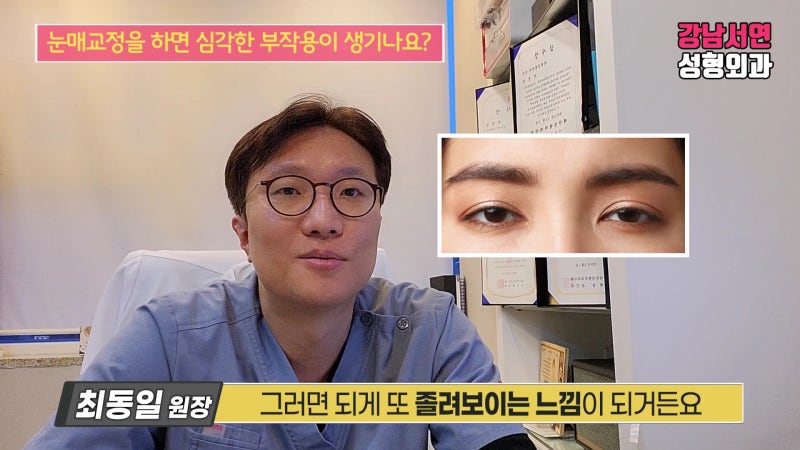
However, if a person with severely sleepy-looking eyes only gets double eyelid surgery without ptosis correction, the eyes will still look tired and the shape will not be aesthetic.
In that case, the surgery would lose its purpose.
Therefore, it is better for those who need ptosis correction to receive it.
However, since indiscriminate surgery on those who don’t need it can cause issues, you must receive an accurate diagnosis from an experienced doctor.
Ptosis correction is a long-established procedure documented in medical textbooks, so there is no need to think that it ‘always’ causes problems.
‘Is ptosis correction mandatory for incisional revision surgery?’

Some ask if ptosis correction is a must when performing incisional double eyelid revision.
It is not mandatory.
This is because some people can open their eyes wide and well without ptosis correction.
For those individuals, there is no significant need for it.
However, there are cases like this:
When we open the surgical site for an incisional revision, we might find that the levator muscle (the muscle that opens the eye) has become detached or there are internal issues.
If we see that the muscle is already detached, we cannot simply leave it in that state just because the patient said they didn’t want ‘ptosis correction’.
In such situations, we must naturally restore it to its normal position, which in itself can create the effect of better eye-opening, similar to ptosis correction.
So the conclusion is: if you can open your eyes well, you don’t need ptosis correction. It is a case-by-case situation.
‘I don’t want any skin excision’

Recently, some people have come to believe through the internet that skin excision is dangerous, and they refuse it due to a vague fear.
Let me explain this part.
First, it is obviously better to preserve as much healthy tissue as possible during surgery, but there are cases where skin excision is necessary.
Occasionally, patients visit us because they cannot close their eyes after another clinic removed an unnecessary amount of skin. While excessive excision is a problem,
removing a moderate amount of sagging skin is perfectly fine and often necessary.
Furthermore, the reason eyes might not close properly is often due to causes other than skin excision. Let me explain that next.
‘Why can’t I close my eyes after incisional surgery?’
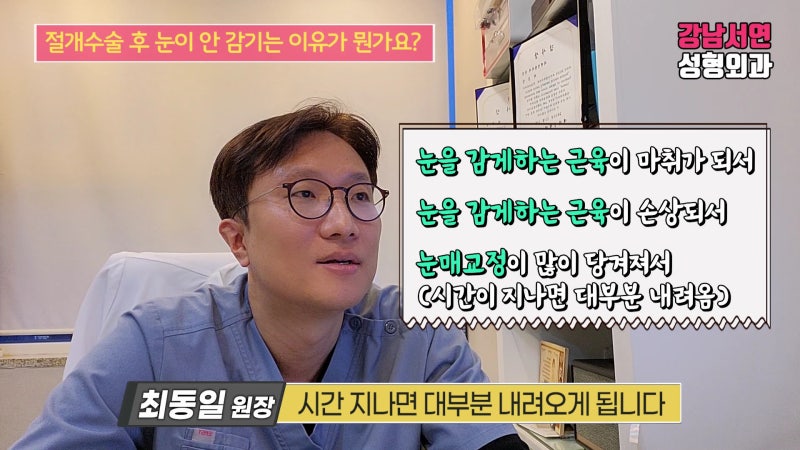
There are three main reasons why eyes might not close fully after incisional surgery:
First, the orbicularis oculi muscle (the muscle that closes the eye) may be temporarily anesthetized, making it difficult to close the eyes immediately after surgery.
Second, if the orbicularis oculi muscle sustains minor trauma during the surgical process, its muscle tone may drop, preventing the eye from closing fully.
Finally, if the ptosis correction was tightened significantly, the eye might not close all the way, but in most cases, it settles down over time.
‘What happens to the threads when switching from non-incisional to incisional revision?’

Some wonder what happens to the existing threads when they undergo incisional revision after a previous non-incisional (buried) surgery.
In most cases, the threads can be removed during the incisional revision.
If a thread is visible or protruding during the incision, we pull it out and remove it.
However, we do not aggressively dig around to find every single piece, so one or two tiny fragments might remain.
Even if they remain, they rarely cause any issues.
In rare cases, a remaining thread might poke through the scar tissue later; if that happens, it can simply be plucked out, so you don’t need to worry—just visit the clinic.
Today, we’ve summarized frequently asked questions about double eyelid revision surgery.
I hope this has cleared up some of your curiosities.
Since there can be a lot of misinformation online,
I hope you will consult with your surgeon to ensure a successful procedure.
For more detailed information regarding double eyelid revision,
you can check out the video below.
↓↓↓↓↓↓
Gangnam Seoyeon Plastic Surgery complies with medical laws. The photos in this post were taken under the same conditions with the patient’s prior consent. Additionally, please be aware that side effects such as bleeding, infection, and inflammation may occur after plastic surgery or procedures depending on the individual.
- Single Specialist System led by the Representative Director - Accurate assessment of eye condition / Recommending only necessary surgeries - Operating room equipped with CCTV |
Feel free to visit us for a 1:1 consultation with our plastic surgery specialist :)
If you have any questions or would like a consultation,
please leave a comment, contact us via KakaoTalk Plus Friend @GangnamSeoyeonPlasticSurgery,
or call us at 02-535-8889 :)




#GangnamSeoyeonPlasticSurgery #GangnamSeoyeon #SeoyeonPlasticSurgery #DoubleEyelidSurgery #PtosisCorrection #MalePtosisCorrection #MaleEyeSurgery #DoubleEyelidReview #ChoiDongIl #DoubleEyelidRevision