2026-06-20
Cases Where Early Correction is Essential After Eye Surgery
Learn about early correction after eyelid surgery, including the ideal timing and specific cases like overcorrection or severe asymmetry where immediate revision is better than waiting.
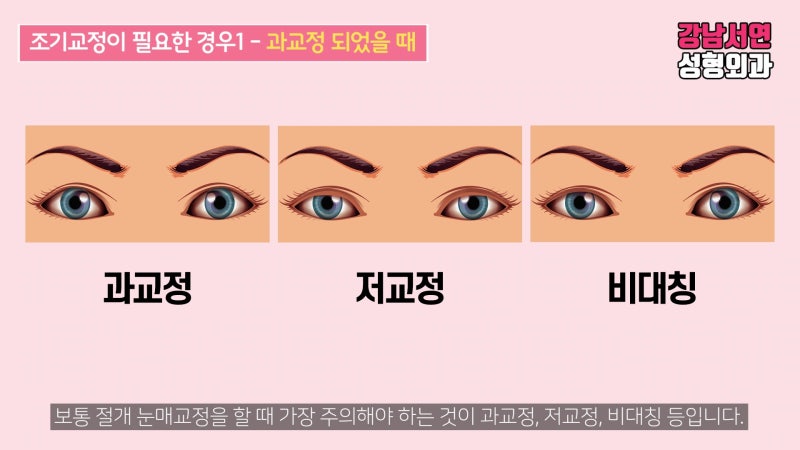
Hello!
We are Gangnam Seoyeon Plastic Surgery Clinic, always doing our best to ensure high patient satisfaction :)
Today, we will take a look at ‘early correction’ after eye surgery with Dr. Choi Dong-il of Gangnam Seoyeon Plastic Surgery.
Let’s explore who should receive early correction and when the best time for it is, along with before-and-after photos.
The photos below have not been edited in any way, except for brightness adjustments :)

Timing for Early Correction
Most patients undergo revision surgery about 6 months after their initial procedure.
However, in rare cases, revision surgery is performed shortly after the initial surgery, usually within 2 to 3 weeks.
In these instances, we perform early correction only when the benefits outweigh the risks.
Specifically, we actively consider revision when the condition is ‘so severe that social life is impossible.’
If the issue is just that ‘the double eyelids on both sides are slightly different,’ waiting is not a bad idea.
However, if ‘the actual size of the two eyes is different,’ I believe early correction is the better approach.
Early Correction Case 1: Overcorrection after Ptosis Correction
The most important things to watch out for during incisional ptosis correction are overcorrection, undercorrection, and asymmetry.
Immediately after ptosis surgery, the eyes may look well-corrected without asymmetry due to local anesthesia and other factors.
However, as time passes, one side may appear overcorrected or undercorrected.
In particular, if one side is overcorrected after surgery, it is better to seek early correction rather than waiting indefinitely.
Sometimes we perform it immediately when a difference in correction amount is noticed during stitch removal (about 1 week post-op), and other times we wait about 2 weeks until more swelling has subsided.
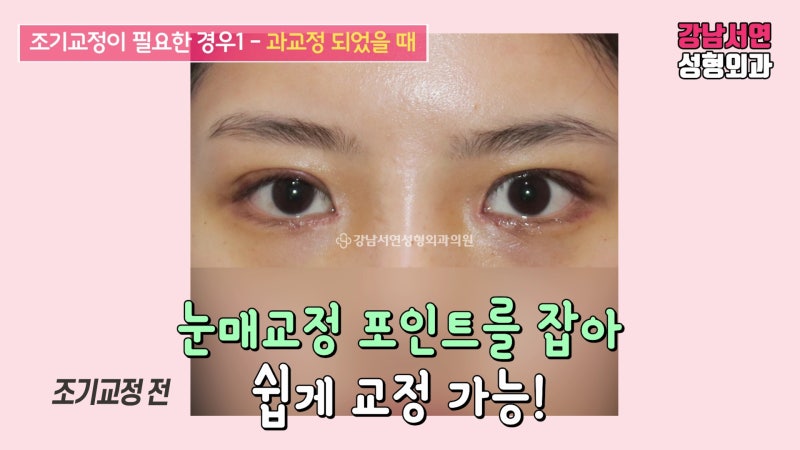
Looking at the photo, this is 1 week after ptosis surgery. The eye on the right side of the photo looks overcorrected, as if it is staring wide open.
In this case, correction is easily achieved by readjusting the ptosis correction point.
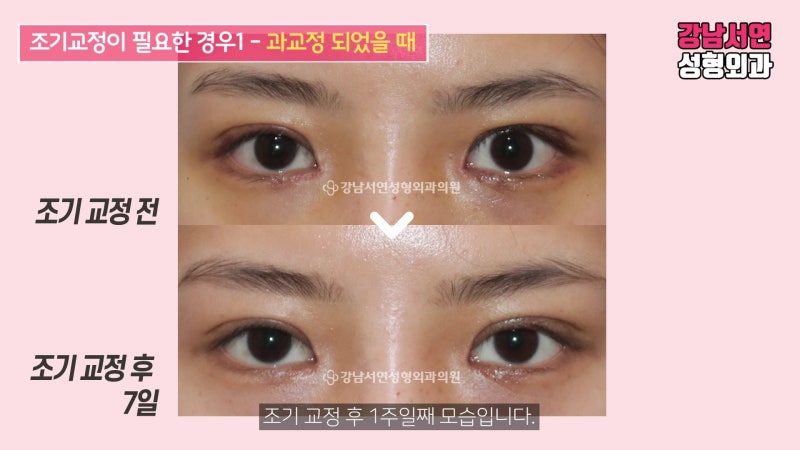
This is the appearance 1 week after early correction.
Early Correction Case 2: Asymmetry after Eye Surgery
Next is asymmetry after double eyelid surgery or ptosis correction.
Naturally, the two sides of a person’s face are rarely perfectly symmetrical.
Since plastic surgery is performed by humans, slight asymmetry can occur after surgery.
While most cases are due to swelling, if the asymmetry is noticeable even after accounting for swelling, it can usually be easily corrected between 1 and 3 weeks post-op.
However, if the surgeon determines that the condition will likely improve after waiting more than 3 months, early correction is not performed.
Of course, in such cases, we provide a thorough explanation before and after surgery, as well as during follow-up visits.
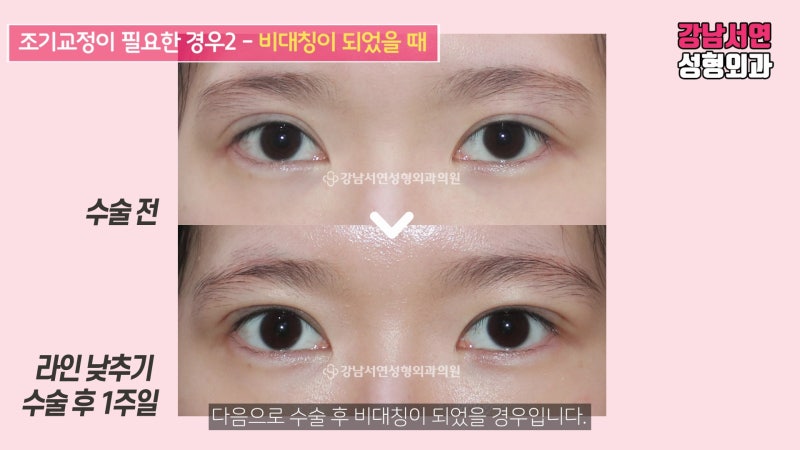
Here is a case of early correction due to post-operative asymmetry.
This patient came to us for a ‘line lowering’ procedure because the eyelid line from a surgery at another clinic was too high.
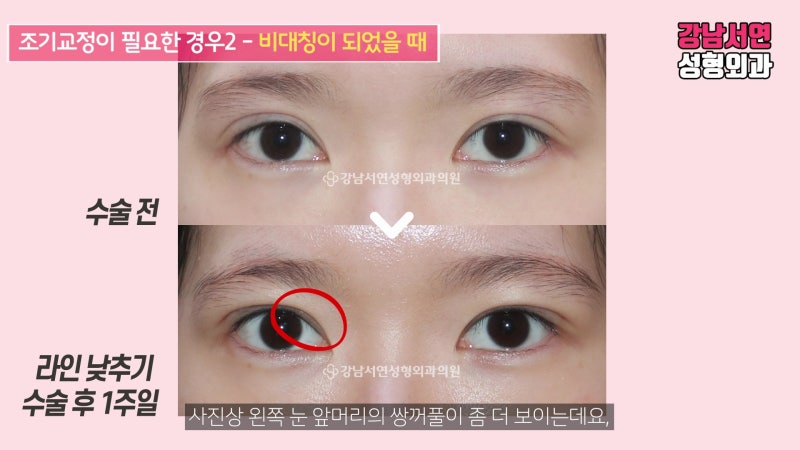
This is 1 week after the line lowering surgery, and some asymmetry is visible at the inner corner of the eyes.
The double eyelid on the left side of the photo is more visible at the inner corner.
We asked for the patient’s understanding and waited for the swelling to subside a bit more.
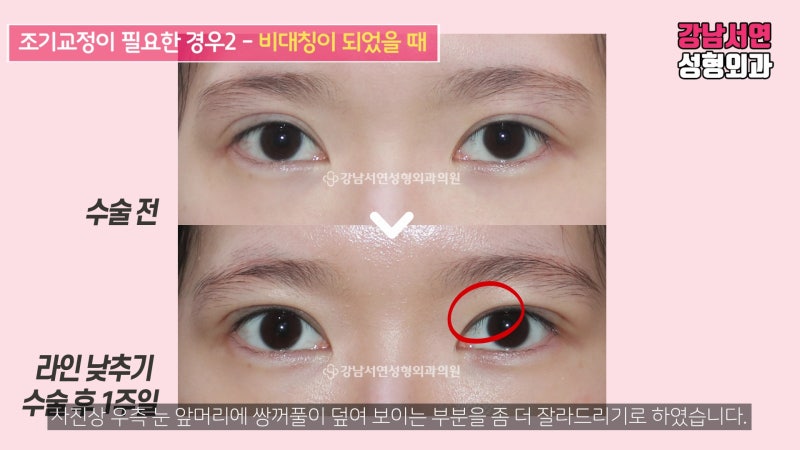
Since the difference persisted at 2 weeks, we decided to trim the part where the double eyelid appeared covered on the right side of the photo.
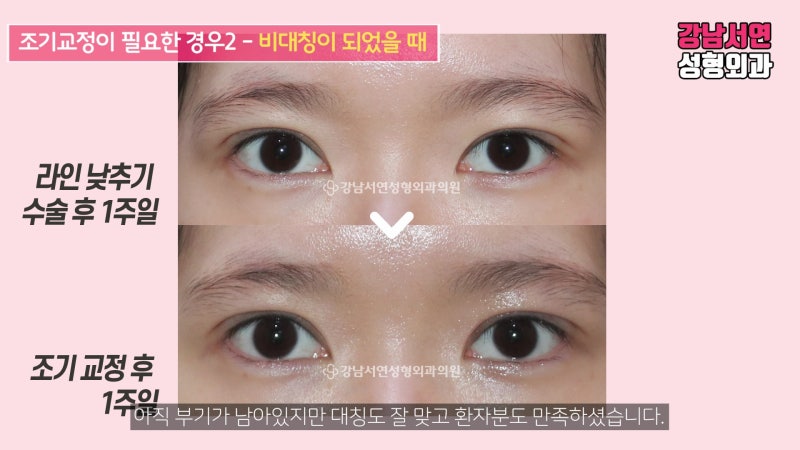
This is the appearance 1 week after early correction.
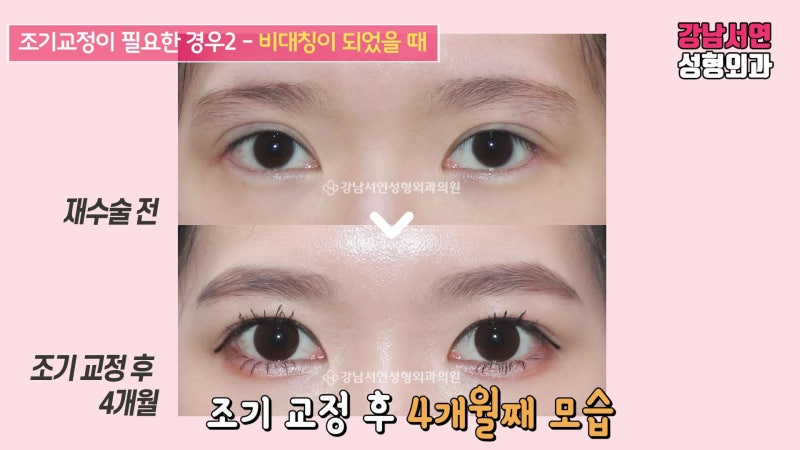
This is the appearance 4 months after early correction.
Early Correction Case 3: Severe Conditions
Next are cases where early correction is unavoidable because the condition from a previous surgery is so poor that social life is nearly impossible.
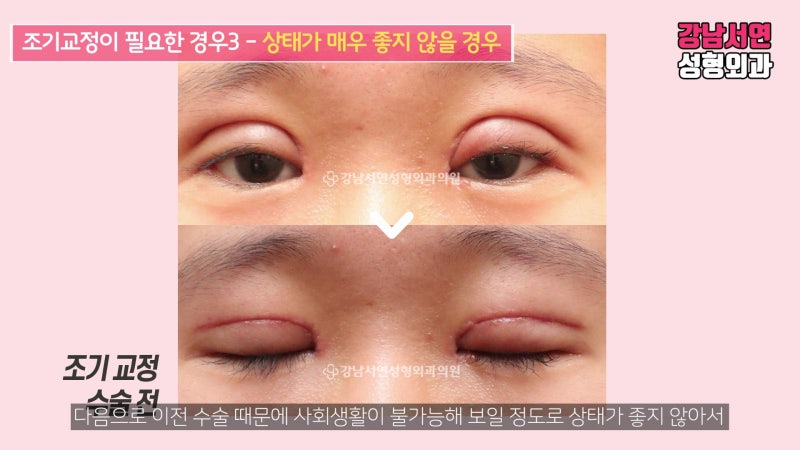
This patient had surgery at another clinic about a month prior. While it is usually best to wait 6 months for revision, the patient was under extreme stress, so we had no choice but to perform the revision at the one-month mark.
Looking at the photo before early correction, the line is so high that it is difficult to open the eyes properly, and because it hasn’t been long since the first surgery, the previous surgical scars are clearly visible.
This patient underwent early correction using the ‘two-line release’ (du-jul-tta-gi) technique.
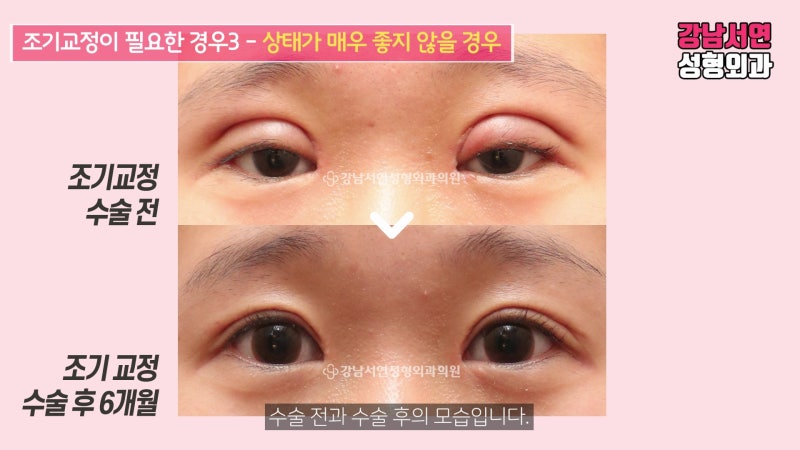
Comparison of before and after surgery.
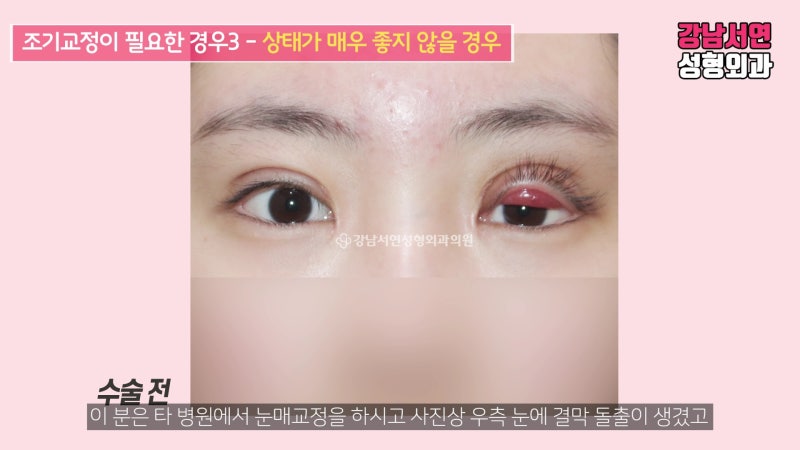
Here is the next case.
This individual had ptosis correction at another clinic and visited our clinic with their original surgeon because of conjunctival protrusion in the right eye (on the photo) and severe mucosal/eyelash eversion (flipping).
Generally, revision surgery is best performed within 2 weeks, or after 6 months for minor corrections.
In this case, leaving the patient in this state for 6 months would have been too difficult, so early revision was performed.
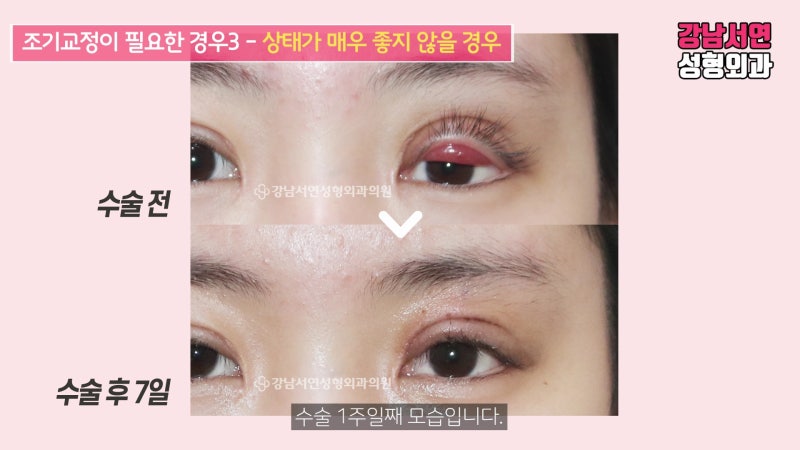
This is the appearance 1 week after surgery.
Since the surgeons for each eye were different, the shapes may vary slightly.
We will monitor the progress for over 6 months, and if the asymmetry remains severe, a re-correction will be performed.
We have looked into early correction after eye surgery (ptosis correction, double eyelid surgery, etc.).
While it is usually best to wait 6 months, there are cases where immediate early correction yields better results or prevents complications.
Therefore, it is essential to confirm the possibility of early correction and the surgical plan through a thorough consultation with an experienced surgeon.
Gangnam Seoyeon Plastic Surgery Clinic complies with medical laws. The photos in this post were taken under the same conditions with the patient’s prior consent. Please note that side effects such as bleeding, infection, and inflammation may occur after plastic surgery or procedures depending on the individual.
- Single Specialist System led by the Representative Director - Accurately assesses eye condition / Recommends only necessary surgeries - Equipped with operating room CCTV |
Feel free to visit us for a 1:1 consultation with a board-certified plastic surgeon :)
If you have any questions or would like a consultation, please leave a comment, contact us via KakaoTalk Plus Friend @GangnamSeoyeonPlasticSurgery, or call us at 02-535-8889 :)






#GangnamSeoyeonPlasticSurgery #SeoyeonPlasticSurgery #DoubleEyelidSurgery #PtosisCorrection #MalePtosisCorrection #MaleEyeSurgery #EyelidSurgeryReview #ChoiDongIl
Frequently Asked Questions
When is it best to get early correction after eye surgery?
It is generally recommended to receive it 2-3 weeks after the surgery. While general eye reoperation is recommended after 6 months, if the condition is severe and the benefits of early correction outweigh delaying the surgery, it can be performed within 1-3 weeks.
If both eyelids are slightly different, should I get early correction?
No, it's better to wait for the swelling to subside for slight asymmetry. However, if the size of both eyes is clearly different or the asymmetry is severe even considering the swelling, it is advisable to consider early correction within 1-3 weeks.
What should I do if one eye is overcorrected after ptosis correction?
Yes, it is better to get early correction rather than waiting indefinitely. If there is a significant difference in the correction amount when removing the stitches about 1 week after surgery, it can be done immediately, or the ptosis correction points can be readjusted and corrected around 2 weeks later, after some swelling has subsided.
Is early correction possible even after one month has passed since the first surgery?
Yes, it is possible if the condition is severe. If the double eyelid line is too high, making it difficult to open the eyes, or if conjunctival protrusion causes stress to the point of making social life impossible, reoperation can exceptionally be performed at one month using techniques like the double-line method.