2026-06-20
A Detailed Look at the 'Two-Line Method' (Dujulttagi) for Eyelid Revision
Learn about the Two-Line Method (Dujulttagi), a specialized double eyelid revision technique for lowering high creases when skin is scarce.
Hello!
This is Gangnam Seoyeon Plastic Surgery Clinic, where we always do our best for highly satisfying surgical results :)
Today, we are going to take a look at the ‘Two-Line Method’ (Dujulttagi).
Many patients visit our clinic curious about what this method is, while others come in specifically requesting it without fully understanding the details.
Since much of the information on the internet is not provided by doctors and can be inaccurate, I would like to explain this first.
Today, I will explain what the Two-Line Method is, why it is performed, and the potential side effects or possibilities that may arise when undergoing this procedure.

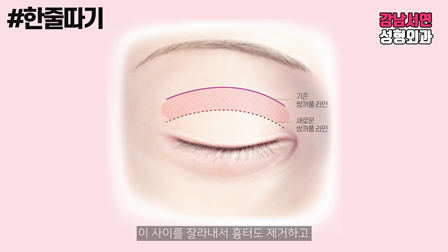
The ‘One-Line Method’ (Skin Excision)
To correct a high double eyelid crease, if there is an existing line, a new line is created below it.
Then, the skin between the two lines is excised to remove the scar and release adhesions, allowing a new, lower line to be formed.
This way, the old scar is hidden and the line can be lowered.
This is commonly referred to as the ‘One-Line Method’.
The ‘Two-Line Method’ (Dujulttagi)
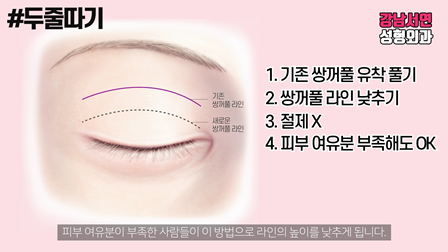
The Two-Line Method is a surgical technique that lowers the height of the crease by releasing the adhesions of the existing double eyelid and creating a new line below it.
A more formal term would be ‘Double Eyelid Revision Surgery Preserving the Existing Incision Scar’.
The Two-Line Method lowers the eyelid height without excising the scar, making it the preferred method for people who lack sufficient excess skin to lower their crease.
Instead of cutting away skin, a new incision is made below the existing scar to simply release the internal adhesions.
Q. If the scar isn’t excised, won’t there be two scars?
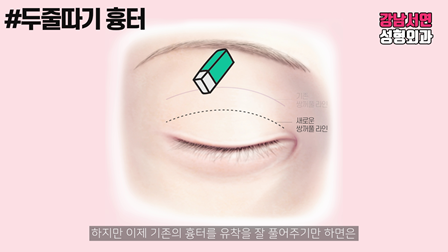
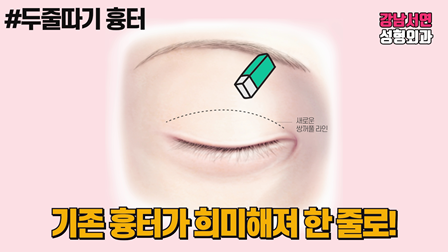
The Two-Line Method involves making a new incision below the old scar and releasing adhesions without removing skin.
You might think, ‘Wait, then won’t I have two scars?’
However, if the adhesions of the old scar are properly released, only the new line will be prominent, while the old scar will fade and become faint.
Reasons for Choosing the Two-Line Method
So, why do we perform the Two-Line Method?
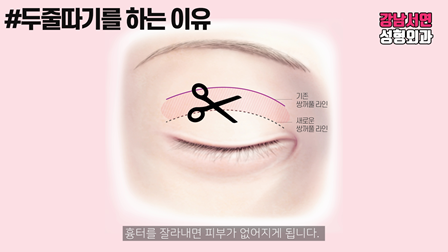
As shown in the diagram above, if you excise the scar, skin is lost.
Since this can lead to a shortage of eyelid skin, cases that require preserving every bit of skin must use the Two-Line Method (no skin excision).
Before and After Two-Line Method Surgery
#Cases where the crease is too high and does not fold properly
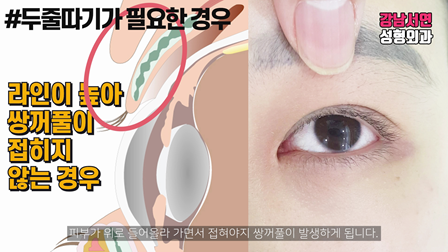
A double eyelid is only a double eyelid if it folds.
Looking at the diagram above, the skin must lift and fold inward for a double eyelid to be created.
The skin below the eyelashes must fold upward and inward.
If only an incision line is drawn but it doesn’t fold, what happens?
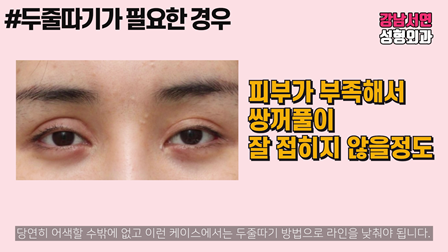
Like this patient, if there is only an incision scar and the skin doesn’t fold, there is no double eyelid—only a visible scar.
This naturally looks awkward, and in such cases, the line must be lowered using the Two-Line Method.
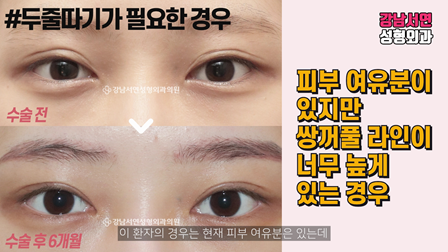
In this patient’s case, there is some excess skin, but the crease is currently too high.
If we were to excise the area between the new line and the old scar, the skin would become insufficient, so the Two-Line Method is necessary.
#Cases where the line is lowered as much as possible to hide the crease
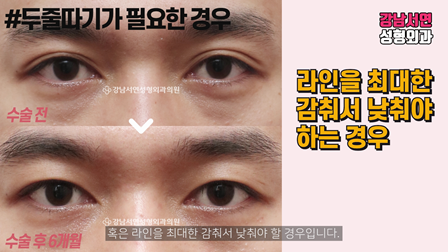
This is for cases where the line needs to be lowered and hidden as much as possible.
In these instances, the skin must cover the crease so it isn’t visible.
This is often used for men who want their double eyelids to be nearly invisible.
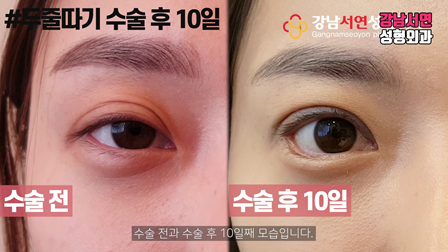
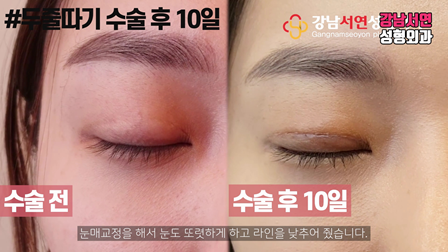
These are the views before surgery and 10 days after surgery.
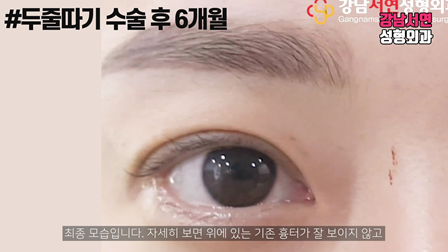
This is the appearance 6 months after the Two-Line Method surgery.
#Cases where the crease is too high and looks burdensome
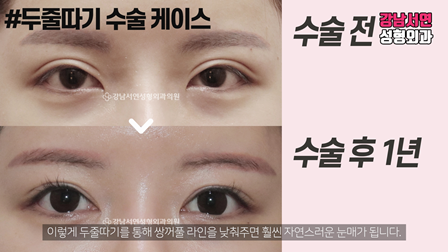
Photos showing before and approximately 1 year after the Two-Line Method surgery.
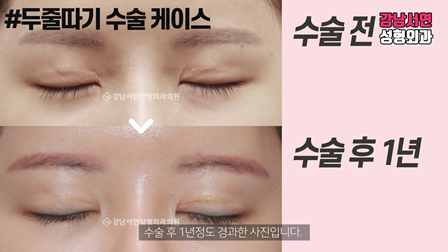
The appearance when eyes are closed 1 year after surgery.
The faint line above is the old scar, and the slightly darker line below is the scar from the Two-Line Method.
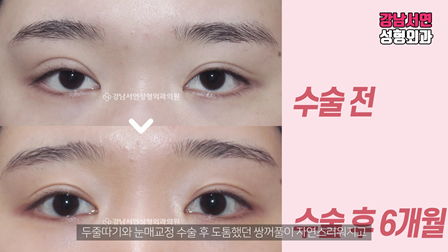
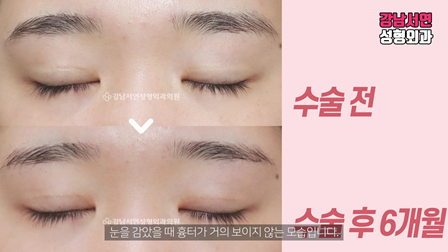
In this case, the Two-Line Method was used to lower the line on the right eye, and since the area near the nose felt slightly sleepy, ptosis correction was performed simultaneously.
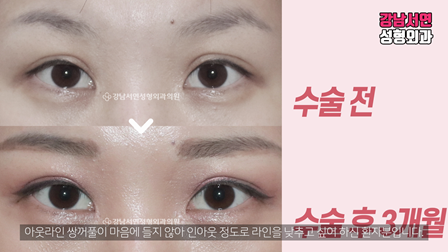
Another case.
This patient was unhappy with their ‘out-line’ double eyelid and wanted to lower it to an ‘in-out’ line.
#Is ptosis correction mandatory?
Some people ask if ptosis correction must be done during Two-Line Method surgery.
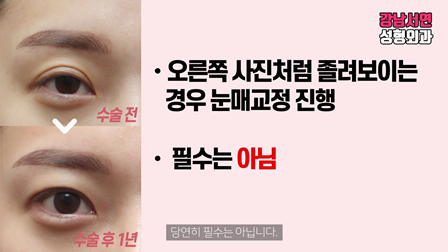
It is recommended for patients who look sleepy, like in the photo above, but it is certainly not mandatory.
Side Effects of the Two-Line Method
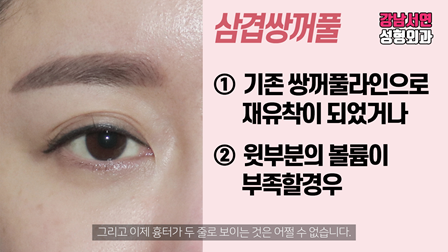
If a ‘triple fold’ occurs, the surgery can be considered unsuccessful.
In this case, the most common cause is re-adhesion at the site of the original double eyelid.
Here is an example of a triple fold. This person did not undergo the Two-Line Method, but I am showing it as an example:
A triple fold is when an additional fold occurs above the double eyelid line.
If the Two-Line Method fails, the line will fold once more at the site of the original scar.
There are various ways to prevent this.
Who is a good candidate for the Two-Line Method?
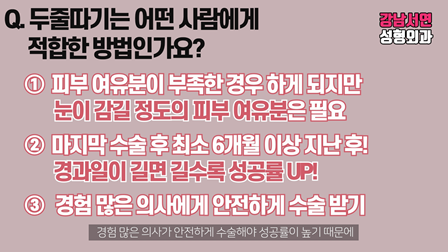
First, the Two-Line Method is performed when there is a lack of excess skin, but there still needs to be a minimum amount of skin available. It must be enough for the eyes to close properly to be worth attempting.
Also, at least 6 months should have passed since the last surgery; the longer the recovery period, the higher the success rate.
Furthermore, in revision cases, there are many unexpected variables once the eyelid is opened. Therefore, the success rate is higher when an experienced doctor performs the surgery safely. It is important to consult with a board-certified plastic surgeon to confirm if this method is right for you and to make a careful decision.
You can find more details in the video below.
↓↓↓↓↓↓
Gangnam Seoyeon Plastic Surgery Clinic complies with medical laws. The photos in this post were taken under the same conditions and with the patient’s prior consent. Additionally, please be aware that side effects such as bleeding, infection, and inflammation may occur after plastic surgery or procedures depending on the individual.
- Single Board-Certified Plastic Surgeon Representative Director System - Accurately assesses eye condition / Recommends only necessary surgeries - Equipped with operating room CCTV |
Feel free to visit us for a 1:1 consultation with our board-certified plastic surgeon :)
If you have any questions or would like a consultation,
please leave a comment, contact us via KakaoTalk Plus Friend @GangnamSeoyeonPlasticSurgery
or call us at 02-535-8889 :)






#GangnamSeoyeonPlasticSurgery #GangnamSeoyeon #SeoyeonPlasticSurgery #DoubleEyelidSurgery #PtosisCorrection #MalePtosisCorrection #MaleEyeSurgery #DoubleEyelidReview #DrChoiDongIl #TwoLineMethod #Dujulttagi
Frequently Asked Questions
What is the double-line revision surgery?
It is a revision surgery that releases the adhesion of the existing double eyelid and creates a new line below it to lower the height. It is suitable for cases where there is not enough skin to cut out the existing scar, and the key is to lower the line while preserving the scar.
Will I have two scars after double-line revision surgery?
No. If the adhesion of the existing scar is properly released, only one scar will be clearly visible. Over time after the surgery, the old scar will fade, and only the newly created line will naturally become the double eyelid.
Is ptosis correction mandatory for double-line revision surgery?
No. Ptosis correction is not mandatory. However, for patients who have weak eye-opening strength and appear sleepy before surgery, ptosis correction can be performed together if necessary.
What are the possible side effects after double-line revision surgery?
The most common side effect is a triple eyelid. This is a phenomenon where adhesion reoccurs in the existing double eyelid area, causing the skin to fold once more above the line, and it is important to thoroughly release the adhesion during surgery to prevent this.
When can I undergo double-line revision surgery?
It is possible at least 6 months after the previous surgery. The longer the recovery period, the higher the success rate of the surgery, as the tissues need to stabilize. Also, there must be a minimum amount of skin available for the eye to close.