2026-06-20
4 Months After Revision Surgery for Triple Folds, Mucosal Exposure, and Ptosis
A detailed case study of a patient who underwent revision surgery to correct high out-lines, triple folds, and mucosal exposure (eyelash eversion) after a previous surgery.
Hello!
To ensure surgery with high satisfaction,
Gangnam Seoyeon Plastic Surgery Clinic always does its best :)
Today, I would like to show you a case of a patient who underwent revision surgery at our clinic after having double eyelid surgery at another hospital.
This patient experienced mucosal exposure (eyelash eversion), triple folds, and slight ptosis after their initial surgery elsewhere.
They wanted to improve these issues and change their ‘out-line’ double eyelids to an ‘in-out line’ through revision surgery.
Today’s post will be very helpful for those interested in:
1) Triple fold double eyelids
2) Eyelash and mucosal exposure (eversion)
3) Asymmetric ptosis
4) Lowering out-line double eyelids to an in-out line
The photos below have not been edited in any way, except for brightness adjustments :)

Condition of the Eyes Before Revision Surgery
This patient visited our clinic after experiencing several problems following an incisional ptosis correction surgery at another hospital.
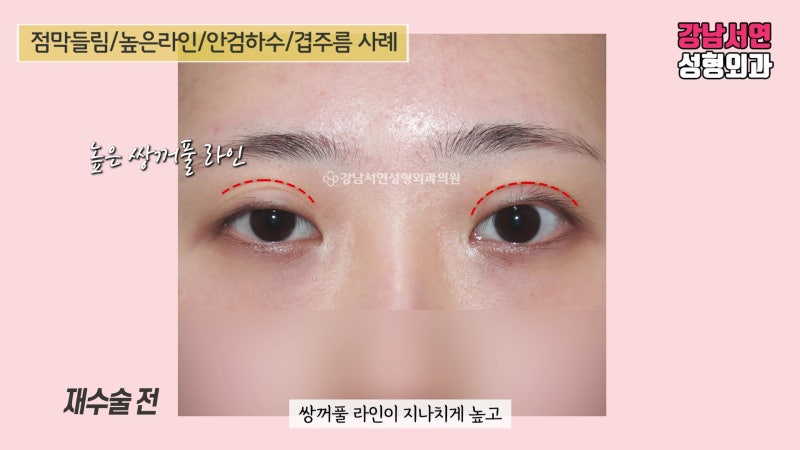
Looking at the photos, there are five major areas that needed improvement.
1) The double eyelid line is excessively high.
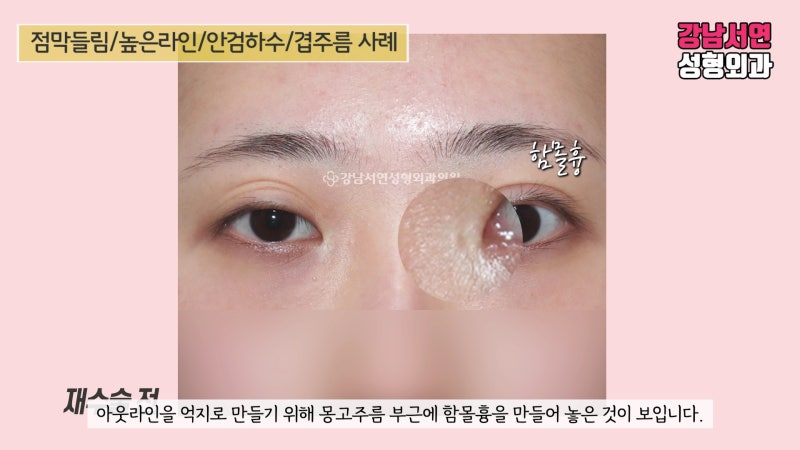
2) Sunken scarring is visible near the epicanthal fold, caused by a forced attempt to create an out-line.
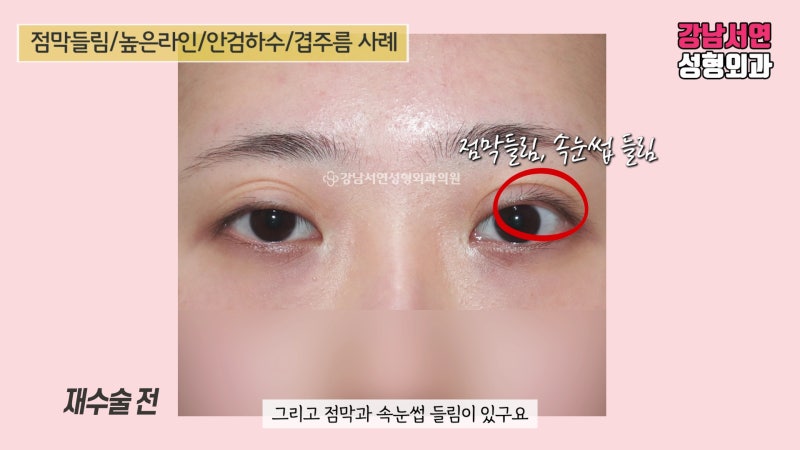
3) There is mucosal and eyelash exposure (eversion).
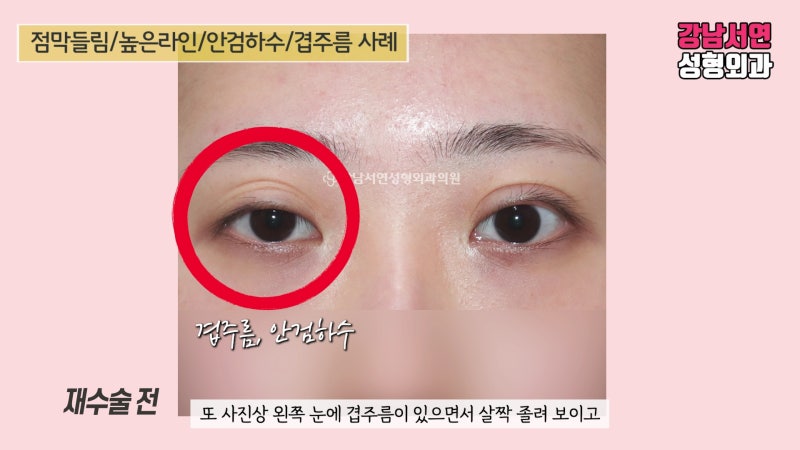
4) The eye on the left side of the photo has triple folds and looks slightly sleepy.
5) The eyes appear asymmetric.
Surgical Goals and Methods
The goals of the surgery were:
1) To lower the line
2) To change the out-line double eyelid to an in-out line
3) To correct the mucosal and eyelash exposure as much as possible
4) To resolve the triple folds
5) To make both eyes as symmetrical as possible
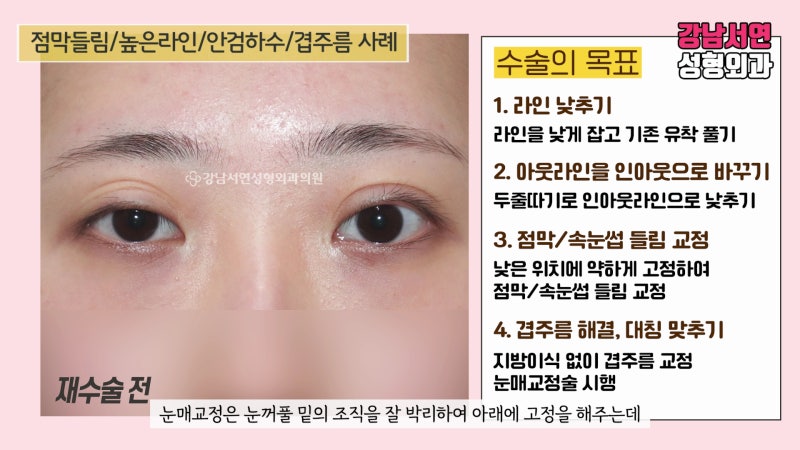
First, to lower the line, a lower line was designed and existing adhesions were released.
Then, the out-line was changed to an in-out line using the technique commonly known as ‘du-jul-tta-gi’ (double-line skin fold release).
Mucosal and eyelash exposure correction was performed simultaneously, but it was not the primary focus. If this correction is performed too aggressively, it can lead to functional side effects. However, by securing the fixation at a lower position with the appropriate tension, mucosal and eyelash exposure is usually corrected naturally.
Regarding triple folds, I personally prefer methods that avoid fat grafting whenever possible, so this patient proceeded without fat grafting.
For the sleepy-looking eye on the left side of the photo, it was discovered during surgery that the levator muscle was detached and damaged. Therefore, ptosis correction was carefully re-performed.
Ptosis correction involves dissecting the tissue under the eyelid and fixing it lower. Since excessive dissection can further damage the orbicularis oculi muscle (the muscle that closes the eye) and potentially worsen lagophthalmos, it is crucial to be treated by an experienced surgeon.
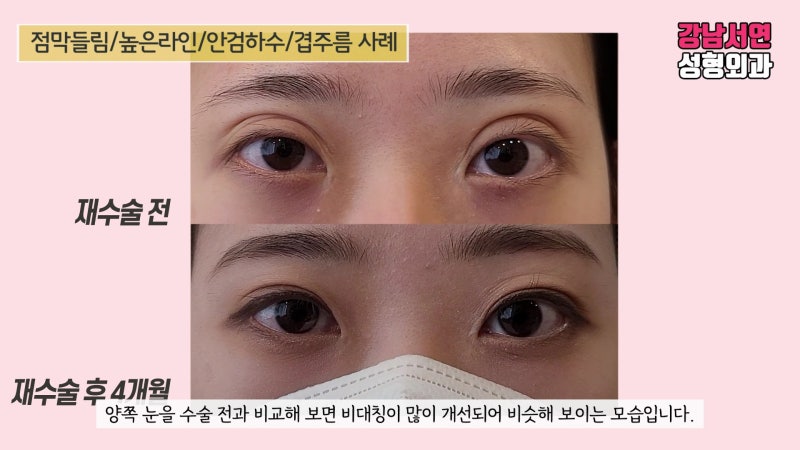
4 Months After Surgery
This is the appearance 4 months after surgery.
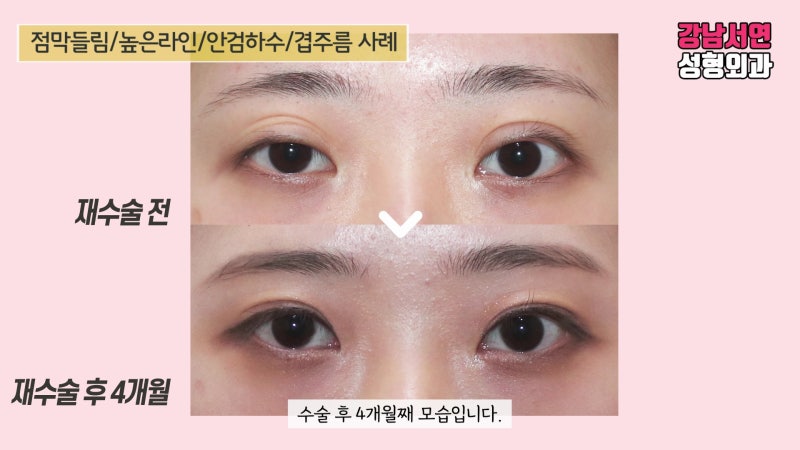
The line was lowered, and the out-line was transformed into an in-out line.
This is the result after correcting the triple folds, mucosal/eyelash exposure, and the sleepy appearance of the left eye.
Efforts were also made to release the adhesions of the sunken scars so they are no longer noticeable.
-
Today, we introduced a case of a patient who struggled with high lines, eyelash/mucosal exposure, triple folds, ptosis, sunken scars, and asymmetry.
During consultations, patients sometimes ask, ‘Are you sure this will be corrected? I will only do the surgery if you can guarantee it.’
However, surgery involves many variables. In ‘extreme’ revision cases, it is difficult to make the eye look as if it never had surgery, and individual satisfaction levels vary.
Therefore, I tell them, ‘I cannot give a definitive guarantee, but I promise to do my absolute best.’
When surgery is performed with the methods I recommend and with my best effort, most patients achieve excellent results.
I hope you can feel at ease and trust our process.
Gangnam Seoyeon Plastic Surgery Clinic complies with medical laws. The photos in this post were taken under the same conditions with the patient’s prior consent. Please note that side effects such as bleeding, infection, and inflammation may occur after plastic surgery or procedures depending on the individual.
- Single Surgeon System by a Board-Certified Plastic Surgeon - Accurate diagnosis of eye condition / Only necessary surgeries recommended - Operating room equipped with CCTV |
Feel free to visit for a 1:1 consultation with a board-certified plastic surgeon :)
If you have any questions or would like a consultation,
please leave a comment, contact us via KakaoTalk Plus Friend @SeoyeonPlasticSurgery,
or call us at 02-535-8889 :)






#GangnamSeoyeonPlasticSurgery #SeoyeonPlasticSurgery #TripleFolds #Ptosis #MucosalExposure #PtosisCorrection #DoubleEyelidRevision #EyeSurgeryResults #DrChoiDongIl
Frequently Asked Questions
Can I change an out-line double eyelid to an in-out line with revision surgery?
Yes, it is possible. By releasing the existing high double eyelid line adhesion and repositioning the line lower, a method often called 'double line revision', an overwhelming out-line can be changed to a natural in-out line.
Can ectropion of the conjunctiva and eyelash eversion that occurred after surgery also be corrected?
Yes, most cases can be corrected. Forcibly correcting ectropion of the conjunctiva and eyelash eversion can lead to functional side effects, so we safely improve the eversion phenomenon by using a method that weakly and securely fixes the double eyelid at a lower position.
Do I necessarily need fat grafting to remove multiple folds on the upper eyelid?
No, it is not always necessary. Although it depends on the patient's eye condition, our clinic prefers not to perform fat grafting if possible, and multiple folds can be effectively resolved simply by precisely releasing adhesions.
Is revision surgery possible for droopy eyes (ptosis) caused by a previous surgery?
Yes, it is possible. If ptosis occurred due to damage or separation of the levator muscle during a previous surgery, this can be accurately identified in the operating room, and the tissue can be carefully dissected and re-fixed through ptosis correction surgery to restore clear eyes.
What should I be careful about during revision ptosis surgery?
Care should be taken to avoid damage to the orbicularis oculi muscle during tissue dissection. Excessive dissection of the tissue under the eyelid can damage the orbicularis oculi muscle, which is responsible for closing the eye, potentially worsening lagophthalmos (inability to close the eye completely), so it is essential to have the surgery performed by a specialist with extensive clinical experience.